This site is not supported by your current browser.
Please use one of these browsers.


OXYvisor™ Oxygen Analyzer
The OXYvisor is a process oxygen analyzer, best utilized to measure oxygen concentration in continuous, online, process monitoring and control applications. It is commonly referred to, as a O2 analyzer, oxygen meter, dissolved oxygen meter or DO meter.
Description

OXYvisor Optical Oxygen Analyzer – Reliable O₂ Measurement in Harsh Biogas Streams
OXYvisor O2 Analyzer Introduction
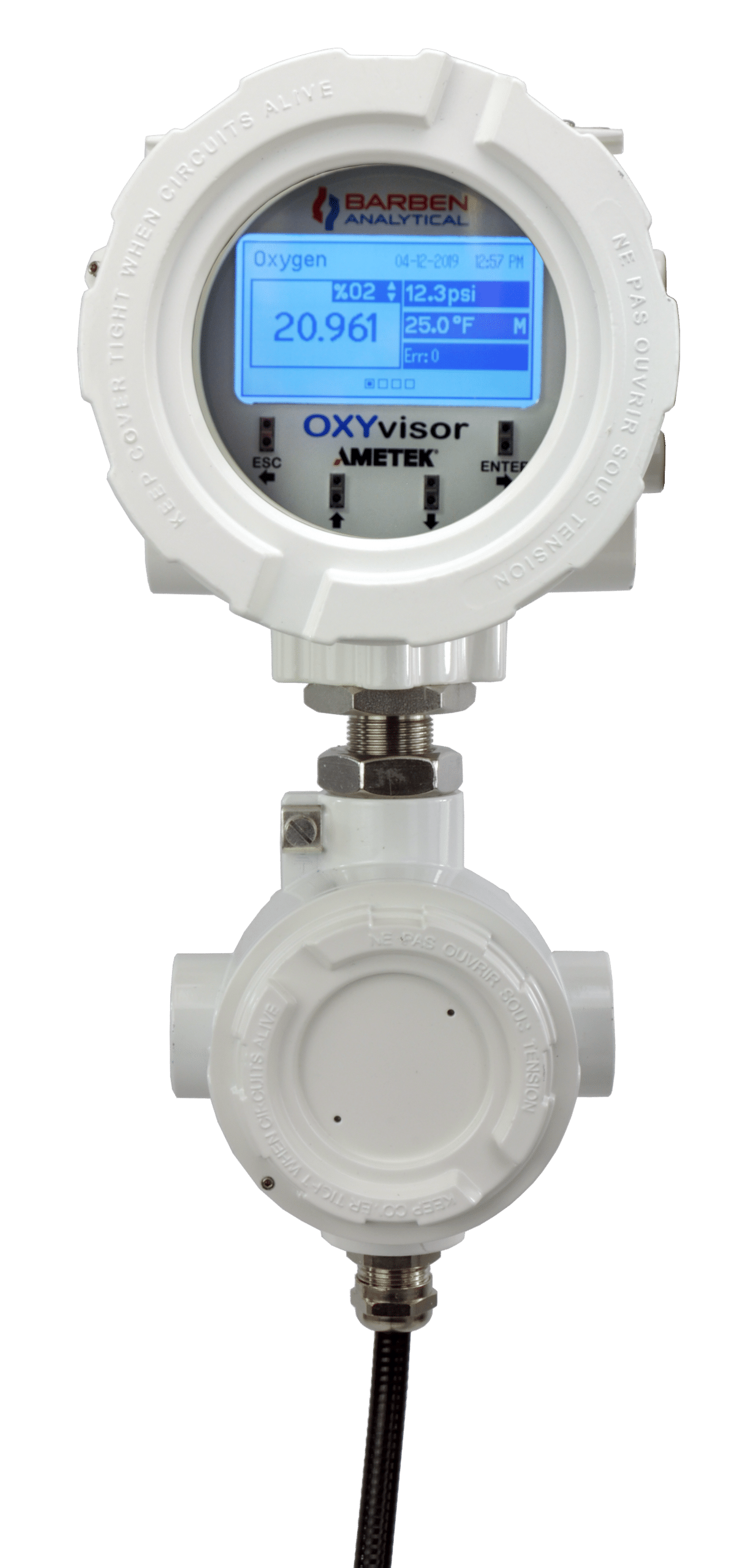
The OXYvisor is a process oxygen analyzer, best utilized to measure oxygen concentration in continuous, online, process monitoring and control applications. It is commonly referred to, as a O2 analyzer, oxygen meter, dissolved oxygen meter or DO meter.
The device utilizes an optical quench luminescent technique to measure oxygen concentration by volume (ppmv, molar basis) in gas phase or dissolved oxygen measurement (ppbv, ppmv) in liquid and aqueous phase applications. The oxygen meter is coupled, via a flexible fiber optic cable, of optional lengths, to a small external oxygen sensor that can be placed into an extracted sample stream, or directly in-situ to the process stream as a gaseous oxygen sensor or when used in liquids as a dissolved oxygen probe dissolved probe or optical DO sensor.
OXYvisor Industrial Applications
Barben OXYvisor is designed for precise and reliable oxygen measurement across a broad range of industrial processes. Its extensive North American (NEC/CEC) and international (IECEx/ATEX) hazardous location certifications—combined with a rugged, corrosion‑resistant design—enable dependable operation indoors, outdoors, in laboratories, and in demanding industrial environments.
The analyzer is widely deployed in Oil & Gas (upstream, midstream, offshore, refining, and petrochemical), manufacturing (annealing furnaces, fiber‑optic and polymer production, contact lens manufacturing), and Renewable Energy sectors, including biogas, biomethane/renewable natural gas (RNG), and ethanol production.
Common Application Areas
Upstream & Midstream Oil & Gas
- Trace oxygen measurement (ppm) in:
- Vapor Recovery Units (VRUs)
- Gathering lines and pipelines
- Compression and booster stations
- Gas plant inlets
- Custody‑transfer points
- Monitoring oxygen contamination in CO₂ injection and floodwater systems used for Enhanced Oil Recovery (EOR)
Biogas & Renewable Natural Gas
- O₂ measurement in Biogas/RNG upgraded gas
- Safety monitoring in anaerobic digesters
- Oxygen breakthrough detection in desulfurization stages
- Biomethane / RNG pipeline injection quality control
Why OXYvisor is Ideal for Oxygen Measurement Applications?
OXYvisor’s optical technique is an ideal technology for many of these applications, due to its ability to accurately measure in applications with high moisture or contaminants like H2S, CO2 and H2 with high reliability. It has no electrolyte to poison, no membrane to plug or foul, and is good to operate with high moisture and in liquids. This makes the OXYvisor an ideal upgrade for older technologies, such as paramagnetic analyzers, electrochemical cells (e.g. fuel cells, galvanic dissolved oxygen sensors, amperometric probes & amperometric gas sensors) and even in some cases, zirconia and Tunable Diode Laser (TDL) based technologies.
Features of OXYvisor Process Oxygen Analyzer
- Wide Measurement Capability
- Gas‑phase oxygen monitoring from 0.5 ppm to percent levels
- Liquid‑phase dissolved oxygen from 1 ppb trace levels to high ppm
- Fully temperature‑ and pressure‑compensated readings for stable accuracy
- Highly Resistant to Biogas Contaminants
- Measurement performance unaffected by H₂S, CO₂, SO₂, or H₂
- Ideal for harsh wet biogas and upgrading environments
- Smart Calibration & Validation
- Standard two‑point zero/span calibration
- Auto‑Calibration and Remote Validation built in
- Industrial‑Grade Design
- Full hazardous‑area certifications:
- Zone 1 & Zone 2 (IECEx/ATEX/CEC/NEC)
- Class I, Div 2 (cULus)
- IP66 / NEMA 4X enclosure
- Operates from –20°C to +55°C
- Full hazardous‑area certifications:
- Flexible Sensor Options
- Multiple installation formats:
- FiberSense (4 mm O₂ sensor for ¼” tube fittings)
- FlexSense II inline flow cells with replaceable sensor caps
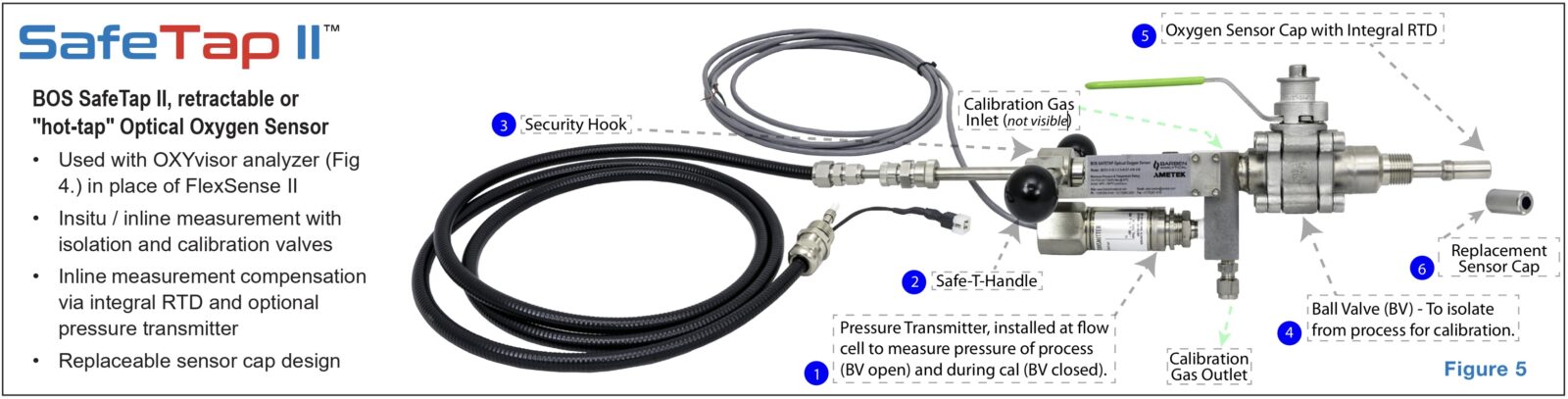
- SafeTap Insitu insertion/retraction probe for process vessels and piping
- Multiple installation formats:
- Easy Setup, Trending & Data Access
- OXYvisor PC software for configuration, diagnostics, and live trending
- Local USB data logging for easy export and reporting
Advantages of OXYvisor Oxygen Analyzer for Biogas/RNG Processing
Advantages of optical oxygen sensors in biogas production include no interference due to moisture, H2S, CO2, and other contaminant gases. The OXYvisor simplifies the sample system design as the contaminant gases do not need to be scrubbed prior to the measurement. In many cases the end user is able to eliminate the highly problematic sample system by going in-situ with the BOSx SafeTap. The end result is increased reliability, better accuracy, and faster response in biogas applications.
To learn more about our products, visit Barben Analytical website.