This site is not supported by your current browser.
Please use one of these browsers.


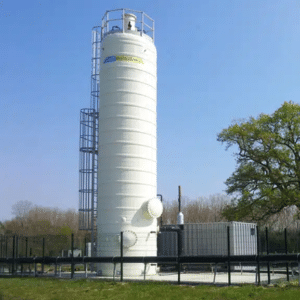
Gas Desulfurization & Conditioning
To enhance the quality of biogas, we need to purify the gas by removing hydrogen sulfide. This desulfurization process is especially crucial for biogas from various waste, converting oxidized H2S into elemental sulfur or sulfate.
Description
Gas Desulfurization & Conditioning
To enhance the quality of biogas, we need to purify the gas by removing hydrogen sulfide (H2S). This desulfurization process is especially crucial for biogas produced from various sources such as the fermentation of waste from agriculture, livestock businesses, wastewater treatment plants, and organic waste facilities.
Innovative technologies effectively absorb and oxidize H2S, converting it into elemental sulfur or sulfate. This strategic desulfurization of natural gas amplifies the quality, safety, and sustainability of biogas. Minimizing environmental impact, equipment corrosion, and SOx emissions. Gas desulfurization is therefore an essential part of the biogas upgrading process.
- Versatile, tailored solutions
- Low-cost and efficient
- Maximized removal efficiency

Tailored Desulfurization Solutions
Various desulfurization technologies are available including absorption with liquids, adsorption with materials, and biological sulfide oxidation. We offer tailored solutions for biogas desulfurization by providing a comprehensive range of options for hydrogen sulfide removal from biogas streams, taking into consideration factors such as operation and maintenance (O&M), capital expenditure (CAPEX), and operational expenses (OPEX).
Hydrogen Sulfide: A Toxic Gas
Hydrogen sulfide (H₂S) in biogas presents significant challenges in renewable natural gas production.
- First, it poses severe health and safety risks, causing fatal complications upon exposure to very high concentrations.
- Second, because of its conversion to sulfate in the atmosphere, H₂S contributes to environmental pollution through SOx emissions, playing a role in the atmospheric sulfur cycle, which contributes to the cooling influence provided by atmospheric sulfate.
- Third, its corrosive nature leads to substantial damage to industrial equipment and machinery involved in biogas upgrading, necessitating costly repairs and maintenance.
Therefore, effective biogas desulfurization techniques are essential for the safe and efficient upgrading of biogas, ensuring the production of clean and sustainable renewable natural gas.
To learn more, please visit our website.
